Conference Table That Reveals True Forms
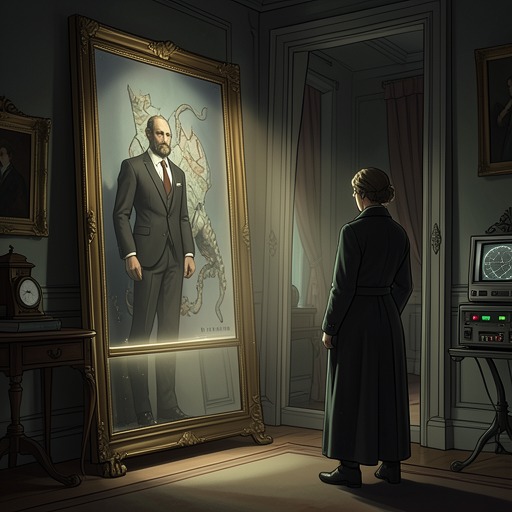
The Portable DoorThe Conference Table That Reveals True Forms is a mirror-polished boardroom table whose reflections disclose magical realities hidden by ordinary appearances. Its distinctive power is not to replace an object’s visible image, but to show that image and a concealed truth at once. The table turns reflection into a means of recognition: what seems to be a mundane object may also reveal the person or creature behind a transformation, making the polished surface an instrument of practical discovery.
Appearance and Operation
The table is described as having a mirror-polished top. Its effect is called an imp-reflecting mirror, though Sophie Pettingell later clarifies that the phenomenon does not depend on a literal mirror or even on a tabletop. The ordinary reflected image remains present; alongside it, the surface discloses another form that would otherwise be hidden. The magic therefore works through doubling rather than simple substitution: the viewer sees both what an object appears to be and what its reflection reveals it to be.
The table’s effect had previously been explained to Paul Carpenter by Ricky Wurmtoter during a lecture of dire warnings. Paul remembers that explanation when he encounters the table again, and the memory gives him the interpretive key to a puzzling reflection. The surface does not announce its meaning by itself; a viewer must notice the difference between the object and its reflected image and know that such a difference can carry evidence.
Earlier Revelation
Paul recalls an earlier instance involving Kurt Lundqvist, whom dark sorcery had transformed into a mouse. The table’s reflection disclosed the transformed man through the image, establishing that its use is not confined to exposing a disguise or identifying a hidden creature. It can also reveal the person beneath an imposed magical alteration. The episode makes the tabletop’s double image a practical counter to magic that changes outward form: the apparent shape persists, but it does not exhaust what the reflection can show.
That precedent matters because it gives Paul grounds to trust what he sees later, even when the revelation arrives in an unexpected form. The table’s operation is consistent across the two encounters, while the objects and circumstances differ: first the reflection exposes Kurt Lundqvist’s mouse form, and later it identifies a person concealed within the reflection of office equipment.
Recognition of John Wellington Wells
During a later crisis, Paul looks away while Humphrey Wells threatens Sophie. His attention falls on the long stapler on the table, an object he has seen appear and disappear before. Its recurrence is familiar enough that he initially gives its presence little thought. The decisive detail is not the stapler itself, however, but its reflection in the polished tabletop. Remembering Ricky Wurmtoter’s explanation, Paul looks at the reflected image rather than relying on the object’s ordinary appearance.
The reflection shows both a stapler and a tiny bald man in a black frock coat and grey striped trousers, crouched and waving urgently. Paul recognizes the man as John Wellington Wells. In this moment, the table turns a recurring, apparently incidental office object into a channel of communication: the reflected figure conveys that John Wellington Wells is present in a form Paul would not otherwise recognize. The table does not itself break the spell or resolve the danger; it lets Paul identify who is reaching him and attend to the warning that follows.
Beyond the Boardroom
Sophie later tells Paul that the same effect need not be produced by a mirror or tabletop and can be obtained with ordinary tinfoil. She describes a sheet of it fixed to the ceiling of Shaz’s bus, directly over the bed. Her explanation extends the table’s principle beyond the boardroom and beyond a specially polished surface: the revealing function can be reproduced with a commonplace material placed in a specific setting. The account connects the magical device to the discovery surrounding Shaz, although the foil’s precise result is not established in the exchange itself.
The contrast between an enchanted-seeming boardroom fixture and household tinfoil gives the table’s power a practical, even makeshift character. Its importance lies less in an exclusive material form than in the unusual relation between an object, its reflection, and what a viewer can recognize there. A surface normally treated as a passive background becomes evidence, while the familiar object reflected on it may carry a second identity.
Narrative Significance
The table makes the difference between appearance and reality legible without erasing appearance. Its reflections do not merely tell Paul that something is wrong; they supply a specific identity he can act upon. The earlier revelation of Kurt Lundqvist and the later recognition of John Wellington Wells establish the table as a recurring device for seeing through magical transformations, with each new instance making Paul’s learned understanding more consequential.
Its method also gives material form to a broader problem in the story: magic can alter what people seem to be, but altered appearances need not be final or fully convincing. A reflection becomes a test of that appearance, and the tabletop’s smooth surface—first ordinary furniture in a boardroom, then a means of recognizing a hidden person—quietly changes the balance of knowledge in a dangerous scene. Sophie’s tinfoil example further suggests that the function is portable and reproducible, so the table is best understood not only as a singular magical object but as the clearest demonstrated instance of a wider revealing effect.